
rediffGURU Ulhas Joshi answers your personal finance and mutual fund queries

'Given the inherent volatility, investors should take at least a three to five-year view.'

Equity-oriented mutual fund schemes in India experienced a 5 per cent decline in net inflows in April, reaching Rs 38,440 crore, while monthly Systematic Investment Plan (SIP) contributions also saw a decrease.

Foreign Portfolio Investors (FPIs) have withdrawn Rs 14,231 crore from Indian equities so far in May, extending the total outflow for 2026 to over Rs 2 lakh crore, driven by persistent global macroeconomic uncertainties including inflation, interest rates, and geopolitical risks.

'In the medium to long term mid-caps tend to generate higher returns, albeit with increased volatility.'


If you want his advice on your mutual fund investments, please mail your questions to getahead@rediff.co.in with the subject line, 'Mutual Fund Query', along with your name, and Omkeshwar will offer his unbiased views.

Bhuvneshwar Kumar's impressive performance in IPL 2026 has sparked debate about his potential return to the Indian T20I squad.

Smaller stocks continue to shine at the bourses. The BSE MidCap index is up 18 per cent since the beginning of January this year against a 5 per cent rise in the Sensex during the period. With the current rally, the mid-cap index has doubled in value since the end of March 2020 against a 70 per cent rally in the Sensex during the period. On Tuesday, the mid-cap index closed at 21,232, as compared to 17,941 at the end of December 2020. In the same period, the benchmark index moved from 47,751 to 50,193.
The recent stock market crash has been particularly harsh on one investment category -- mid cap stocks/funds. Compared to their large cap peers, mid cap stocks/funds have fallen more sharply. The view that many frustrated investors might take is that investing in mid caps was a bad idea in the first place. And they can't really be blamed, in many ways mid caps were presented as an opportunity to make quick money without informing the investor of the higher risk involved.

With markets getting back their mojo after four months, small- and mid-cap shares raced ahead of large caps in April. The Nifty Smallcap 100 index surged 7.5 per cent - its biggest monthly advance in 10 months - and outperformed the benchmark Nifty 50 index by 350 basis points. The Nifty Midcap 100 index soared 5.9 per cent, most since August.

A total of 10 new stocks have been included in BSE Mid-Cap index, while 12 existing ones would move out.

Ask rediffGURU and PF, MF and insurance expert Purshotam Lal your mutual fund, insurance and personal finance-related questions.
Though many such funds may not make the grade, it would be foolhardy to ignore them
The small-cap universe outperformed large-caps, but failed to match the returns generated by mid-caps in August. The Nifty Smallcap 100 Index rose 4.9 per cent. By comparison, the Nifty50 Index rose 3.5 per cent and the Nifty Midcap 100 soared 6.2 per cent. This was only the third calendar month in 2022 when the small-cap index has outperformed the large-cap-oriented Nifty50 Index.
It was just a couple of months ago when mid caps stocks were a rage.

The relentless rally in small- and mid-cap stocks continues as large-caps show signs of fatigue. In July, the Nifty Smallcap 100 rose 8.1 per cent, extending its year-to-date (YTD) gains to 48.5 per cent, while the Nifty Midcap 100 added 3.1 per cent, taking its YTD rise to 33.5 per cent. On the other hand, the Nifty50 remained unchanged for the month, with YTD gains of 12.7 per cent.

In reality, no single philosophy can dominate every market cycle. That's why we've explained how these approaches work to help investors make informed and realistic decisions.

Indian investors have seen their wealth erode by a staggering Rs 16.77 lakh crore over four trading sessions, as the markets faced deep losses driven by elevated crude oil prices, geopolitical tensions, persistent foreign fund outflows, and a record-low rupee.
Mid-cap stocks have emerged as the clear favourite of investors, both institutional as well as retail, if returns in the last two months is any indication.

Financial year 2025-26 (FY26) saw a significant shift in corporate fundraising, with rights issues more than doubling to a multi-decade high of 51, raising 44,290 crore, while qualified institutional placements (QIPs) more than halved to 29 issues, mobilising 62,954 crore, driven by sharp equity market corrections and regulatory changes.

Real test of the rally in this segment will be the upcoming result season.
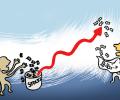
The worst may perhaps be over for these stocks, suggests Sanjay Kumar Singh.
The BSE mid-cap Index will include shares of Allied Digital Services, Cals Refineries, Century Plyboards, Gammon Infra, Hindustan Oil Exploration, Indiabulls Securities, Jai Balaji Industries, Jet Airways, Jindal Drilling, Puravankara Projects, Rain Commodities, S Kumars Nationwide, Shriram City Union Finance, Thermax and Thomas Cook India.
The BSE Small-Cap Index (up 34 per cent) and the BSE Mid-Cap Index (up 28 per cent) have outperformed the Sensex (up 16 per cent) in the last two-and-a-half months, while the NSE Junior Nifty (up 25.4 per cent) and the NSE Mid-Cap Index (up 30.2 per cent) have beaten the S&P CNX Nifty (up 20.4 per cent) during the same period.

While small-caps have delivered higher returns than their large-cap peers, investors would do well to recognise the incremental risk of investing in these companies.

Retiring at 50 is not unrealistic. It simply requires: Discipline + Long-Term Vision + Compounding

Most of the large mid-caps share similar business model as the large-caps and have more of less similar set of clients.

Three fund managers share their views and state where they are looking for value.

'As valuations of large-caps appeared to be out of whack, investors started lapping up quality mid-caps and small-caps, which were available at relatively comfortable valuations.'
Stakes raised significantly in select companies during Dec quarter, pushing sectoral indices up more than larger peers.
Indian benchmark indices Sensex and Nifty experienced declines due to a sharp rally in crude oil prices, continuous foreign fund outflows, and geopolitical uncertainties. Regulatory developments in the banking sector, particularly the implementation of the Expected Credit Loss (ECL) framework, also contributed to the selling pressure.

Unless these companies falter on growth or external and domestic factors play spoilsport, analysts expect them to do well
In anticipation of the IPOs of FCH and RPL, investors were seen off loading small and mid-cap stocks heavily.

Operator syndicate could be behind stock hammering, suspects regulator.
Sluggish volume growth and mark-to-market losses have affected the performance of a majority of mid-cap information technology companies in the January-March 2008 quarter. Analysts expect that growth will continue to be sluggish in the next two quarters.
 © 2026 Rediff.com - Advertise with us - Disclaimer - Privacy Policy - Sitemap - Feedback - About us - Terms of use - Grievances